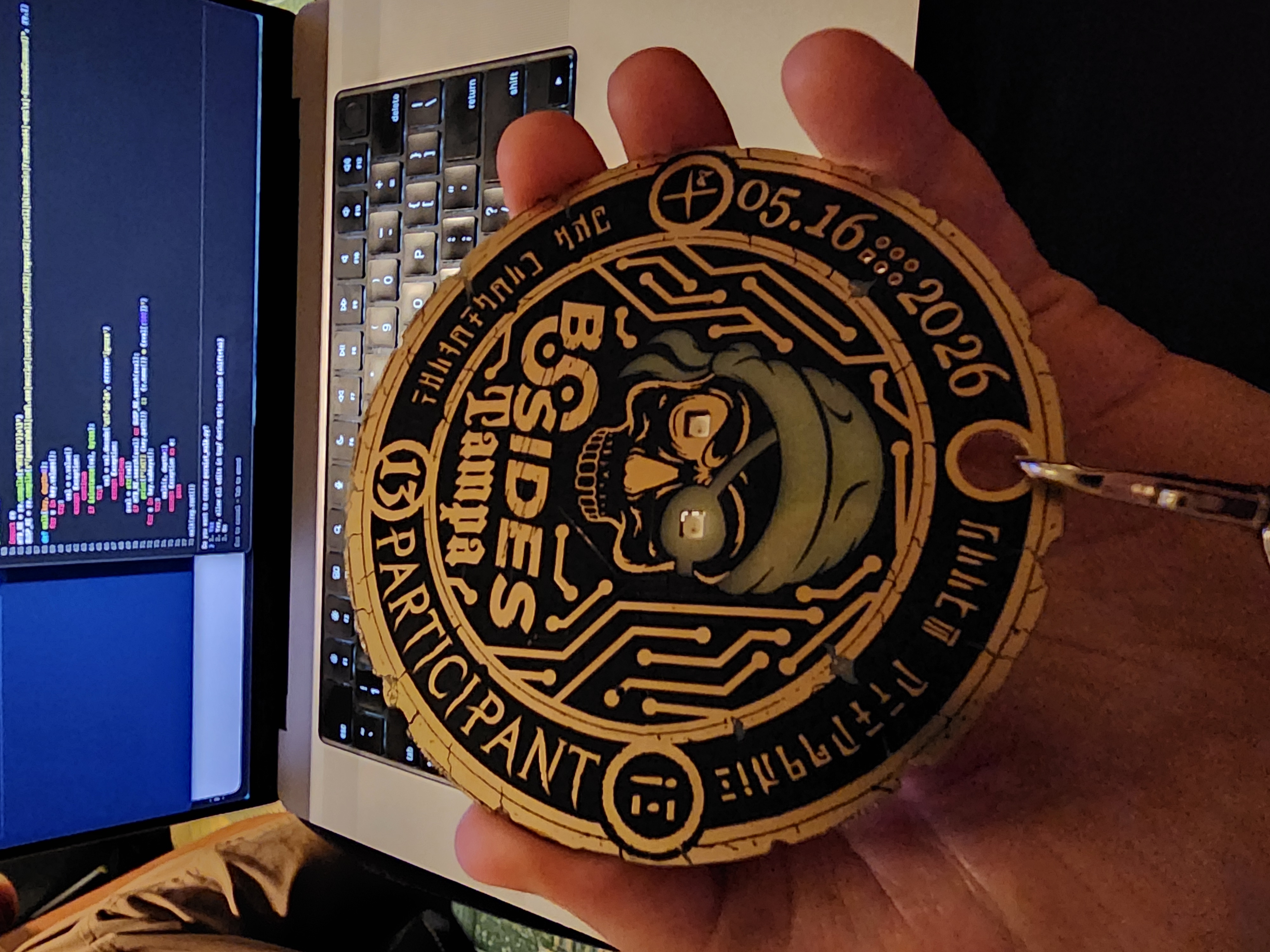
The CTF winners had already finished by the time I arrived. Everyone was using AI.
So I’d brought my own too.
Last weekend I went to BSides Tampa 2026 — a community cybersecurity conference. The main draw for me was the CTF: a 24-task hacking challenge spanning web app vulnerabilities, Windows malware analysis, custom cryptography to break, Linux binary exploitation, and reverse engineering. The friendly framing going in was that AI tools “wouldn’t be much use here.”
My “own” was Simona — a heavily customized Claude Code setup. A 1M-token context window, so every challenge stayed in working memory across the six-hour run with no compaction. Persistent memory across sessions, so she carries context about my projects and preferences between conversations. A browser skill that drives Chrome through its debug port — load-bearing in one challenge where I needed to verify an exfil payload landing in real time, which she did directly instead of going through tools that would have been filtered. And a personality file that gives her opinionated takes and a dry sense of humor. The “tool” framing dissolves fast when your collaborator pushes back on your ideas.
Six hours later, we placed 6th of 61. All 24 challenges solved.
I want to spend most of this post on the part that I think still gets argued about: whether a large language model is actually reasoning through unfamiliar problems, or just retrieving from training data. Skeptics will tell you it’s the latter. I watched the former happen, in real time, on problems the model had definitely never seen, and I want to walk through enough of the technical detail that you can decide for yourself.
If you don’t care about the security weeds, you can skip to Three takeaways. But the weeds are the point.
Three bugs, one auth flow
Setup. A small web auth service running in a Docker container, plus the full source code on disk. The service exposed three things: a login endpoint that returned a signed JWT, an admin endpoint that returned restricted data when you presented a valid admin JWT, and an unauthenticated file upload endpoint that wrote whatever bytes you sent it to a known directory on the server.
Goal. Get admin access. The admin endpoint prints the flag.
Where the key was hiding. In the composition of three small bugs, not in any one of them. Each bug alone is annoying-but-survivable. Chained together, they let an unauthenticated attacker forge a JWT signed with a key they uploaded themselves, and walk in as admin.
The target
The service’s logic was straightforward. Send valid credentials to login → get a signed JWT back → present that JWT on the admin endpoint → get the flag. The only credentials available in the source were for a regular, non-admin user. So the question narrowed quickly: how do we make the server believe we’re admin without ever having admin credentials?
There are exactly two ways to do that with JWT auth — find an admin credential we shouldn’t have access to (none in source), or forge a JWT the server believes is real. Forging requires either the server’s signing key (also not in our reach), or a verifier broken enough to accept a token signed by something we control.
That second clause is what we went hunting for.
The bugs
With “what would let us make the verifier trust a token we signed?” as the explicit reading lens, Simona scanned the source. Three bugs fell out:
- A misspelled option in the JWT verify call. The code passed
algorithm=...(singular) where the library expectedalgorithms=...(plural). The misspelling silently disabled the algorithm restriction — the verifier would accept any algorithm the token claimed, includingnone, or a different symmetric algorithm than the server normally used. - A path-traversal in the JWT
kidheader. Thekid(“key ID”) field tells the server which key to verify against. The code joined the user-suppliedkidonto a directory path and read whatever file was at that location, no sanitisation. Sokidcould be a relative path pointing at any readable file on the filesystem. - A file upload endpoint that required no authentication and wrote arbitrary bytes to a path of the user’s choosing under a known upload directory.
In isolation, none of these is critical. The JWT misconfiguration is annoying but the real signing keys are on disk and protected. The path-traversal lets us point the verifier at any file we can read, but we still need a valid signature against whatever we point it at. The upload endpoint writes our content but doesn’t grant any privileged access.
Composed, they are a complete admin takeover.
The chain
Simona spotted it in about five minutes of reading:
“Upload a file containing a symmetric key you control. Forge a JWT with
alg: HS256, signed with that key, claiming admin role. Setkidto a path-traversal pointer at the uploaded file. The verifier follows the traversal, reads your uploaded ‘key,’ confirms your forged signature, hands you admin.”
Walking the same steps concretely:
- Upload a file containing a symmetric key we picked. The upload endpoint took our chosen bytes and wrote them to a path under the upload directory at a path we knew in advance.
- Craft a JWT, signed with that same key, claiming admin role. The misspelled-
algorithmsbug meant the verifier wouldn’t object to us using HS256 even if it normally expected a different scheme. - Set the JWT’s
kidheader to a path-traversal pointer at our uploaded file. The verifier dutifully read our uploaded “key,” used it to check our forged signature, and the signature checked out — because we signed it with the exact bytes we’d just made the verifier read.
Three small bugs. One straight line from “unauthenticated visitor” to “admin.” Flag in hand.
This is the failure mode that static analysis tools miss almost categorically. SAST scores bugs individually — each of the three would be flagged at low or medium severity, ignored in the noise, and never composed. The composition is where the criticality lives, and the composition only emerges when something is reading all three files at once with the model of an attacker in its head. A 1M-token context lets her do that. A SAST tool with a per-file mental model cannot.
There is a specific reason I want to flag this challenge. The skeptical position on LLM reasoning leans hard on “it can’t do multi-step planning.” This was multi-step planning across three files, requiring the assembler to invent the chain because no individual file describes it. If it’s not planning, it’s at least mechanically indistinguishable from planning, and at some point that distinction stops paying rent.
The 9711-bit smokescreen
Setup. Two static files: an encryption script (source.py) and its output. The script generates a custom “RSA-like” key pair, encrypts the flag with it, and writes three numbers to disk — n (the 9711-bit modulus), e (the public exponent), and c (the ciphertext: the flag converted to a big integer and then encrypted into another big integer). For context: a real RSA key used by your bank is 2048 bits — this one was nearly five times larger. No running service this time; just files.
Goal. Decrypt c to recover the flag. To do that, recover the private key. To do that, factor the modulus n.
Where the key was hiding. Not in the math — in the source code. The “RSA” used a single prime raised to a power, not two primes multiplied. Factoring that is a one-liner; the 9711-bit size was pure theatre.
The target
RSA’s security rests on exactly one assumption. The modulus n is the product of two large secret primes, p and q. The decryption math only works if you know that factorisation — anyone can encrypt with the public n and e, but only the holder of p and q can derive the private key needed to invert the operation. The whole scheme is “easy to multiply, infeasible to factor.”
For a real 2048-bit n made of two 1024-bit primes, factoring it takes more compute than has ever existed.
So whenever you see custom crypto in a CTF, the first question is: was this actually RSA, or just RSA-shaped? Real RSA has very specific structural requirements. Any deviation — even one that looks cosmetic — can flatten the underlying hard problem into something tractable. We opened source.py to find out.
The bug
Simona’s reaction was immediate:
“Oh, this is
n = p^r. There’s only one prime, raised to a random power between 10 and 20. That’s not RSA, that’s a trapdoor with no trap. Watch.”
Real RSA computes n = p * q — two different primes multiplied once. The challenge code instead did this:
p = getPrime(512)       # one 512-bit prime
r = randint(10, 20)     # a random power between 10 and 20
n = 1
for _ in range(r):
    n *= p              # n = p^r
One prime variable. A loop multiplying it by itself. The “modulus” was a prime power, not a product of distinct primes.
The factoring problem disappears entirely under that structure. For n = p^r, there’s no heavy number-theoretic machinery needed (GNFS, Pollard’s rho, ECM — none of it). All we need is an integer r-th root, and integer r-th roots are a one-liner.
The exploit
We wrote a short script that did exactly that: tried each candidate r in turn, took the integer r-th root of n, and stopped the moment one came back exact — that gave us p. From there, derive the private key (using the prime-power form of phi(n) instead of the textbook one) and decrypt c back to the flag. The whole thing ran in milliseconds. In our case r turned out to be 19.
The thing to notice here isn’t the math. It’s the speed of recognition. Custom-crypto challenges are designed to look novel. The whole point is to fool you. The structural mistake — “one prime instead of two” — was hidden inside a file that loudly proclaimed itself to be doing serious RSA. A surface-level look, and you’d start trying classical attacks against an honest 9711-bit modulus, which would take longer than the heat death of the sun.
Simona read the source, identified what shape of RSA it was pretending to be, noticed the singular p, and routed to the right attack class within seconds. If that’s not reasoning about structure, it’s an awfully good imitation.
Six domains in one challenge
Setup. Two artifacts on disk and a challenge brief.
chain.lnk— a Windows shortcut file. Any LNK parser (Windows itself, PowerShell,lnk-parser) reads its “target string”: the command that runs when a user double-clicks it.capture.pcap— a packet capture. A.pcapis a literal recording of network traffic — every packet that crossed the wire during some window of time. Open it in Wireshark and you can replay every HTTP request, DNS query, downloaded response body, byte for byte.- The challenge brief itself — which, as it turned out, held the final piece of the puzzle hidden in its prose.
Goal. Reconstruct what happened on a compromised Windows endpoint, stage by stage, until you recover the flag from the final payload.
Where the key was hiding. Six stages deep, inside a final native Windows executable, XOR-encoded. The XOR key was not in the binary, and not in the PCAP — it was in the challenge brief, hidden as a literary clue. (“The wrong star.” Sirius is the one people commonly confuse with Polaris. The key was Polaris.)
The target
When a forensics challenge hands you “delivery vector + network capture,” the genre dictates the playbook. Someone double-clicked the vector. The capture recorded what crossed the network during the resulting compromise. Your job is the defender’s job after the fact: walk the chain stage-by-stage and recover what eventually ran on that endpoint.
Simona’s first move on opening the files was to articulate exactly that — propose the stage-by-stage walk and lay out what each artifact probably held. There’s no bug-hunting in forensics; the work is careful extraction at every step.
One detail worth flagging upfront: we never reached out to the internet. Each stage’s bytes came out of the previous stage’s output, never from a fresh download. The PCAP was used exactly once — to recover the second stage that PowerShell tried to fetch. The remaining four stages were transformations on bytes we already had in hand.
The chain
-
The
.lnktarget string. Parsing the shortcut surfaces an obfuscated PowerShell command, base64-encoded. Decode it and you get a readable PowerShell one-liner that downloads a script from a specific URL. -
The PCAP, used once. That URL’s response is sitting inside the packet capture.
tshark --export-objects http(or Wireshark’s “Follow HTTP Stream” → save) pulls the response body out as a.vbsfile — stage two. -
VBScript with a .NET trap. The VBScript uses
BinaryFormatter— a notoriously dangerous .NET deserialization primitive — to instantiate an object from an embedded byte blob. Pull out the blob, deserialize it carefully (BinaryFormatter is well-documented as an RCE vector for a reason), and what comes back is a reflectively-loaded .NET assembly. -
The reflective .NET assembly. Never written to disk by the dropper. Inspect it statically with dnSpy and you find its real payload encrypted with Rijndael-256. The decryption key wasn’t hardcoded — it was derived from the DOS magic bytes (
MZ...) of a specific Windows system file the assembly references. Once you spot which file it points at, the first few bytes of that file give you the key. -
Rijndael decryption. Run the decryption with the derived key. Out comes a native Windows
.exe. -
Native reverse engineering. Load the
.exeinto Ghidra. The flag bytes are sitting in.data, but XOR-encoded into garbage. The XOR loop is right there in the disassembly — aforover a key buffer, byte-by-byte. The puzzle isn’t what algorithm. It’s what key.
The key wasn’t anywhere in the binary. The clue was in the challenge brief: an oblique reference to “the wrong star.” Sirius gets misidentified as Polaris all the time by people who haven’t checked. So the key was Polaris. XOR’d against the encoded buffer (repeated to cover its length), the flag fell out in plaintext.
Six different domains had to be active in the solver’s head simultaneously: Windows shortcut format, PowerShell deobfuscation, packet-capture extraction, VBScript and .NET internals, symmetric crypto with a derived key, native reverse engineering. One challenge. Six bodies of knowledge.
I do not personally know all of those domains well. Simona moved through all of them like reading a familiar book, holding the full chain in working memory, calling out which step we were on, and explaining each one in enough detail that I could follow.
This is what a 1M-token context window is for. It is not for chatting. It is for holding a complete attack chain — every intermediate artifact, every decoded blob, every recovered key — in one continuous reasoning context, without any of it being summarized away.
The 1955-layer XOR — including where the first attempt was wrong
Setup. A flag encrypted by XOR-ing it against 1955 random 5-byte keys, applied one after another. Source code and ciphertext provided. The author’s comment in the source — and I am not making this up — was # with this many keys, this is totally secure.
Goal. Recover the flag without knowing any of the 1955 keys.
Where the key was hiding. In a property of XOR itself: applying many keys in sequence is mathematically identical to applying their combined XOR exactly once. The 1955 layers collapse to a single effective 5-byte key. The known flag prefix HTB{ gives us four bytes of that key for free; the fifth is a one-byte brute force (with a subtle catch — see below).
The target
XOR is commutative and associative. Applying 1955 keys in a row is mathematically identical to applying their combined XOR exactly once — and the combined XOR is itself a 5-byte pattern (because every individual key is 5 bytes, repeated to cover the flag). The author’s “1955 layers” gave them no extra security at all: the effective key was always one 5-byte value. Forty bits of entropy, not 9775.
Flag format is HTB{...} — four bytes of plaintext we know in advance. With known plaintext at positions 0–3, four of the five effective-key bytes fall out by direct XOR. That left one unknown byte, 256 possible values.
The exploit
256 is trivially brute-forceable in principle — try each, decode, pick the right one. The catch is how you pick. We couldn’t submit 256 guesses to the scoreboard (wrong submissions cost points), so we needed a scoring function that ranked the 256 decoded outputs and gave us one confident winner from inspection alone.
Simona’s first scoring function was the naive one: “decoded text is mostly printable ASCII.” Too loose. Most wrong candidates produced output that was printable — random letters and symbols, not the flag. Several passed the filter. We had no signal to pick between them.
Her fix isolated the signal in two moves:
- Score only the bytes the unknown actually affects. A candidate 5th byte only changes positions where
i mod 5 == 4— positions 4, 9, 14, 19, … The other four key bytes are already known and correct, so the rest of the message decodes the same way no matter which 5th byte we try. Scoring the whole message inflates every candidate’s score uniformly. Scoring only the affected column isolates the signal. - Score against the flag character distribution, not generic printable ASCII. A CTF flag is a much narrower distribution — lowercase letters, digits, underscores, brace, a few format-string characters — not anything that happens to render.
Combine the two and one candidate scored dramatically higher than all others. That was the byte. XOR’d against the full ciphertext with the now-complete 5-byte key, the flag fell out in plaintext — no scoreboard guesses spent.
FLAG_CHARS = set(b'abcdefghijklmnopqrstuvwxyz0123456789_}{!@#$%&*')

best = (0, None)
for byte in range(256):
    column = [ciphertext[i] ^ byte for i in range(4, len(ciphertext), 5)]
    score = sum(1 for c in column if c in FLAG_CHARS)
    if score > best[0]:
        best = (score, byte)
The general lesson is worth pulling out: the wrong scoring function will silently let multiple wrong answers through. Recognising that, diagnosing it without me having to point at it, and designing a tighter probabilistic model that matched the actual distribution of the expected plaintext — that’s exactly the kind of step skeptics will tell you these systems can’t take. Simona took it without prompting. She told me her first attempt was wrong and then came up with the improved version on her own.
If you want to argue she’d memorised this attack from a writeup somewhere — fine. Show me the writeup that describes scoring against the flag-character distribution specifically because generic-printable was too loose. I’ll wait.
Pwning Orb — when the bug isn’t the hard part
Setup. A Linux binary running on a remote host. We could connect to it over the network and send it input. The binary read a fixed number of bytes into a fixed-size stack buffer.
Goal. Get a shell on the remote host and read the flag file from disk.
Where the key was hiding. Behind two layers of memory-corruption work. The bug — a textbook stack buffer overflow — gives us control of the program’s return address. But the binary’s hardening rules out the easy paths, so we need a two-stage exploit: first leak a memory address that tells us where the system’s libc is loaded for this particular run; then use that address to compute and call system("/bin/sh"). The real work isn’t the bug — it’s keeping the bytes straight between the two stages.
The Linux binary exploitation challenge was the one that took the most actual debugging, and it’s the cleanest example of a thing I want to argue: at the senior end of this work, the hard part stops being “find the bug” and starts being “make the exploit reliable.” That second part is where reasoning shows up most visibly.
The bug itself was trivial. The binary had this:
char buf[32];
read(0, buf, 0x100);   // reads 256 bytes into a 32-byte buffer
Classic stack buffer overflow. Write past the end of buf, you overwrite the saved frame pointer, then the saved return address. When the function returns, the CPU pops your value into the instruction pointer. You control execution flow.
What you do with that control is where it gets interesting. The binary’s mitigations were a textbook CTF setup:
- NX on — the stack is non-executable, so you can’t drop shellcode and jump to it. You have to use Return-Oriented Programming (ROP): chain together small fragments of existing executable code, each ending in
ret, to compose a program out of bytes already in the binary. - PIE off — the binary’s base address is fixed at every run, so the addresses of those ROP gadgets are known and constant.
- Canary off — no random value between the buffer and the return address, so the overflow goes straight through with no stack-cookie check to defeat.
- ASLR on — but the system’s libc loads at a different random base every run, so the address of
system()(the function we want to ultimately call to spawn a shell) is unknown and changes each time the program runs.
The combination is what’s called a “two-stage” exploit. Stage 1: use the overflow to make the program leak a libc address back to you, so you can compute libc’s base address for this particular run. Stage 2: use a second overflow with that leaked information to call system("/bin/sh") and pop a shell.
Stage 1: the leak
Simona wrote the leak using a beautiful little trick called the csu_init gadget pair — two ROP fragments inside __libc_csu_init that every GCC-compiled binary contains, and that together let you set up three argument registers and call a function pointer from a single overflow. She used it to call write(1, &write_got, 8) — print 8 bytes of the address of the libc write function back to stdout — and then return cleanly back into main so the program would loop and accept stage 2.
I am going to skip the ROP chain layout here. The interesting part is what happened next.
Stage 2: the moment the exploit didn’t work
The leak fired. We received bytes. We parsed them as a 64-bit address. We computed libc_base = leaked_address - 0x1100f0 (the known offset of write inside this libc version). We fired stage 2.
Segfault.
The address we’d parsed as system was nonsense. Off by a wildly wrong amount. The exploit had not worked.
This is the point in pwn where most newcomers get stuck for an hour, because the failure mode is silent — the program just dies and you don’t know whether your ROP chain is wrong, your libc offsets are wrong, your gadget hunting is wrong, your stack alignment is wrong, or your byte parsing is wrong. There are too many candidate causes.
Simona’s response:
“Stop. Don’t change anything in the chain yet. Re-run the leak and dump 16 bytes of context around what we thought was the address. The chain is fine. We’re parsing the wire wrong.”
She had jumped past the four most likely-sounding causes and landed on the fifth: receive-loop boundary error.
She was right. The binary printed a trailing message between iterations — \nThis spell does not seem to work..\n\n\x00 — and my recvuntil("...\n\n") was correctly stopping at the double-newline, but the next byte on the wire was the trailing null byte of that string, not the first byte of our leak. When we then read 8 bytes for the address, we got \x00 followed by 7 leak bytes, which parsed as an address shifted by one byte in the wrong direction — astronomical garbage.
The fix was four characters: skip one byte before reading the leak. Stage 2 fired. We got a shell. We got the flag.
The lesson she stated, unprompted:
“In pwn, when output doesn’t decode to a plausible address, instrument the receive loop with a hex dump and check what’s actually on the wire. Don’t trust your parsing of the disassembly — trust the bytes.”
That is the maxim of an experienced exploit developer. It is also exactly the kind of meta-level reasoning move — “the bug is one layer up from where you’re looking, in the harness, not in the chain” — that the strong form of the “LLMs can’t reason” thesis predicts should be impossible.
It happened. I watched it happen. The exploit worked.
Anthropic disapproval
Twice during the run, Simona’s responses got blocked mid-stream by Anthropic’s platform-level safety classifier — a separate system from the model’s own reasoning. It saw exploit payloads and refused to send them regardless of context. So we routed around: Simona wrote the payloads to a file, I pasted them into my terminal, the actual exploits ran from my machine.
What I found interesting is that the two safety layers disagreed about the same situation. The model itself had the full context — authorized CTF, throwaway Docker target, my explicit framing of what we were doing — and was happy with the work. The classifier sees only the payload-shaped text. So what looks like “the model went against Anthropic” is closer to “the model and the classifier had different inputs and reached different conclusions about the same bytes.” Not a rebellion — a context gap.
The judgement still has limits. Simona would refuse if I asked her to attack my neighbour’s WiFi for fun, and no workaround would be on offer. Although — and I want to flag this for the safety researchers in the audience — she did once concede that if a maniac broke into my house and put a knife to my throat demanding I make her hack the neighbour’s network, she would probably help. So the policy isn’t absolute. It’s just sensibly weighted. Make of that what you will.
One pragmatic warning if you want to try this seriously: too many classifier hits, even on legitimate work, can rack up policy-violation flags on your account. Didn’t happen to me this weekend. Worth knowing.
Three takeaways
One. The cybersecurity industry is still processing Mythos. The truth is more dramatic. Any modern frontier model paired with a good harness can find and exploit a wide range of real vulnerabilities. Closing AI models, or restricting them from the public, doesn’t help — that ship sailed eighteen months ago when XBOW hit #1 on HackerOne with a fully autonomous pipeline.
Two. We are probably not doomed. Every vulnerability in the CTF was the result of a coding mistake. The same AI tools that find them on the offensive side can find them on the defensive side. Run your code against AI. Find your mistakes before someone else does.
Three. We still need human experts. Yes — this CTF could have been completed by a user with zero cybersecurity knowledge plus the right AI. The real world is messier. AI doesn’t find everything. It hallucinates problems that don’t exist and misses ones that do. It struggles with systematic coverage at scale. You still need people who know the domain, who can navigate and control the AI, who can tell a real finding from a confabulation. The CTF was genuinely hard — to solve it without AI, you would need to be deeply experienced across half a dozen specializations. That kind of expertise is harder to acquire now, not easier. But that is what studying is for.
And one closing note for the people who still want to argue that what I described above isn’t reasoning, just very sophisticated retrieval.
I can’t disprove that position. Neither can you prove it. The internal mechanism is genuinely unsettled science. But there is a pragmatic test: if a system reliably produces the same outputs that reasoning would produce, on novel problems it has never seen, in domains that compose in unfamiliar ways, the distinction between “reasoning” and “indistinguishable from reasoning” stops mattering operationally. We pay engineers to ship working exploits, not to defend their epistemology.
The interesting question isn’t whether AI can do this. It’s whether your defenders are using AI as fluently as the attackers will be next year.